 2
2
 0
0
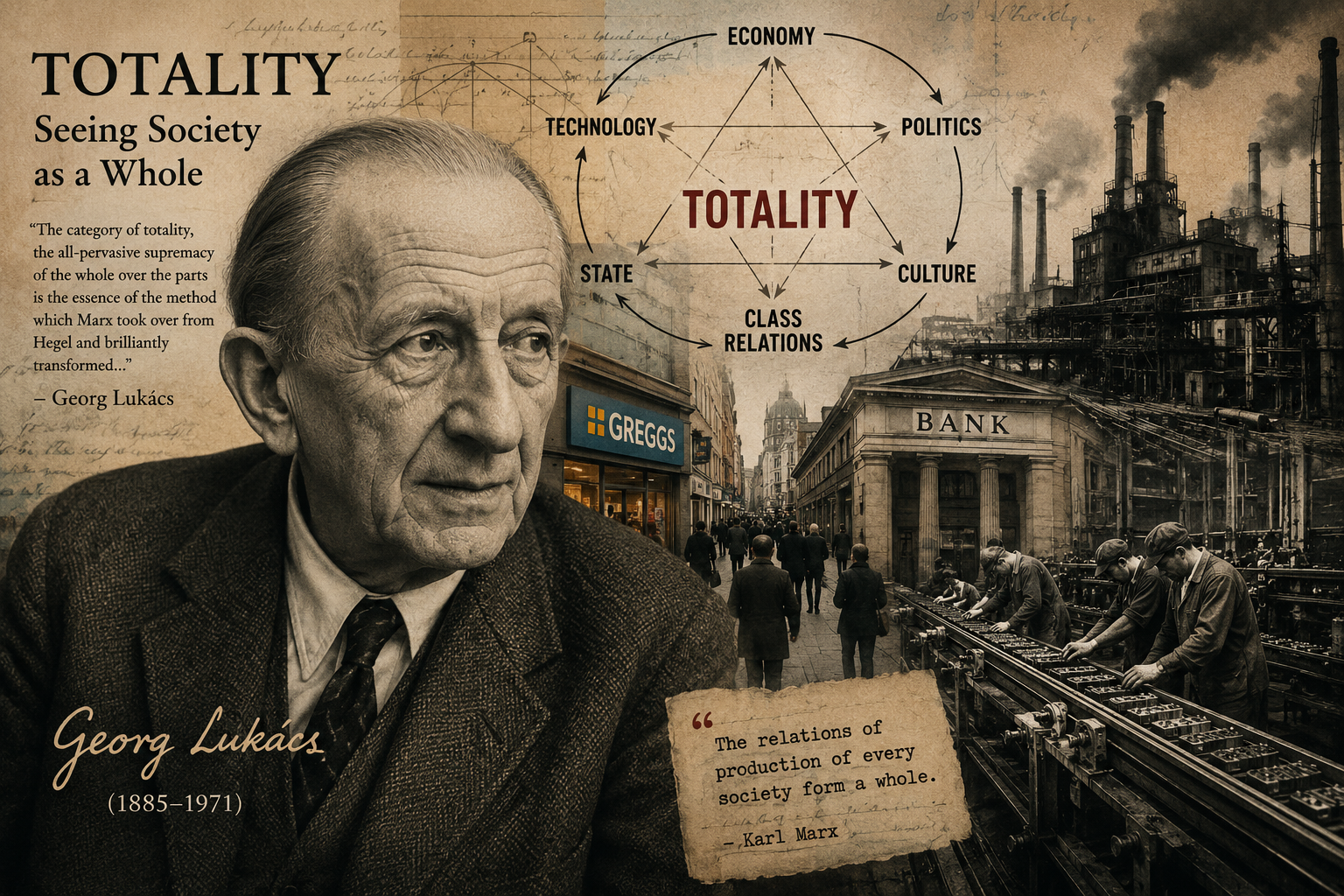
Recently I’ve been reading up Georg Lukács major work: History and Class consciousness. And there’s one major concept that appears not just thoughout the work but stressed as very important by Lukács himself. For us to grasp society properly, we must do more than glance at it. We must consciously take in society as an interconnected, historically developing whole.
Sounds simple I know. Of course society is a whole, we might say. Of course the economy, politics, culture, technology, institutions and individuals interact with one another. But the Marxist concept of totality means something much more precise than the banal observation that “everything is connected.” like some far out New Age stuff. It is a methodological principle: social phenomena must be understood in relation to the structured whole of which they are a part.
Our everyday perception of society is fragmented and I can’t stress that enough. We encounter individual objects, people, institutions and events separately like some independent monad in the vacuum of space. We see a bank, a supermarket, a factory, a school, a government office and a railway station. We experience our own job, our wages, our rent, our commute and our relationships as distinct aspects of life. We can become accustomed to treating each as an isolated fact, governed by its own particular logic.
This fragmentation is precisely what dialectical thought attempts to overcome as Lukács puts it:
“They take the facts in abstract isolation, explaining them only in terms of abstract laws unrelated to the concrete totality.”
The crucial opposition here is between the abstract and the concrete.
Abstraction is indispensable to thought. We cannot think without isolating particular aspects of reality. The problem arises when the abstraction is mistaken for the reality itself.
Consider a wage. We can abstract from the social relations surrounding it and simply regard it as a numerical quantity: £15 an hour wage rate in the UK. We can then formulate statistical laws about wages, employment and productivity. Such analysis may be perfectly accurate as far as it goes. But the £15 wage does not exist in isolation. It is part of a determinate social relationship between a worker and an employer, the class struggle! That antagonistic relationship exists within a wider system of private property, commodity production, labour markets, capital accumulation and class relations. The isolated fact is therefore an abstraction. The concrete reality is the fact understood through the relations that constitute it.
This is why totality does not mean “everything that exists.” No human being could possibly take the entire universe into account every time they analysed a social phenomenon. A totality is instead a structured whole of mutually mediated relations.
To give a non-marxist example that still illustrates the logic. Think of a simple electrical circuit. A battery, copper wire and incandescent bulb can be considered separately. But the functioning of the bulb cannot be adequately understood by considering the bulb in isolation. The battery, wire and bulb form a circuit. Each occupies a determinate position within the whole, and the function of each depends upon its relation to the others. Likewise, a foundation and the bricks built upon it are not merely two unrelated objects sitting beside one another. Their relationship gives them a determinate function within a structure.
The social totality is vastly more complicated, but the principle is similar: a part cannot always be adequately understood apart from the relations that constitute its place within the whole.
An individual, for example, does not exist in social and historical isolation. The individual is mediated through family, law, education, language, institutions, economic relations, history and relationships with other people. To say this is not to deny individual agency. It is to recognise that agency itself takes place within historically specific social relations.
The individual is therefore both an individual and a social being.
This brings us to another essential characteristic of totality. The whole is not simply a collection of separate parts:
A + B + C = society.
That conception gives us a static picture. Dialectical totality is instead dynamic:
A ↔ B ↔ C ↔ A
The arrows matter.
The parts are not merely sitting beside one another. They are in relations of mutual determination. They affect one another, condition one another, reproduce one another and sometimes transform one another. Society is therefore not a photograph but an ever-changing process. A change occurring in one part can reverberate through the wider whole, while changes elsewhere can alter the conditions under which that original part exists. A technological innovation can transform the organisation of production. Changes in production can have knock on effect on employment. Changes in employment can affect household life and consumption. Changes in consumption can affect markets and investment. Social movements can force political changes. Political changes can subsequently alter economic relations. The movement is not simply linear or one-sided. It is an ever-changing network of mediated relations.
This is the Hegelian inheritance within Marxist dialectics: the totality is internally differentiated and in continual development.
Marx’s materialist transformation of this dialectical insight is crucial. Marx does not begin with an abstract society floating above material life like some fairytale castle in the clouds. He investigates the concrete relations through which human beings produce and reproduce their existence.
He famously writes:
“The relations of production of every society form a whole.”
Note the word “whole”. The relations of production are not an assortment of independent economic facts. They form a determinate structure. The organisation of production, property relations, labour, exchange, distribution and class relations exist in relation to one another. This is also why Marx’s concept of the productive forces must be understood concretely. The productive forces are not merely machines. They include the means of production together with living, active labour: machinery, tools, factories, infrastructure, technological knowledge and human labour-power operating within a social process of production. Consider a familiar scene on a British high street, The Greggs bakery. Joe Blogs passes by one of them. The chap might think about whether he wants a sausage roll. He may tilt his head gawking at one through the window, considering the price. He might walk inside and buy one or he’ll scoot off.
Nothing wrong with this ordinary perception. It’s the way everyday people go about their ordinary business operating at the level of immediate appearances. But those of us that are dialectical thinkers ask questions, we want to go further.
That Greggs is not simply a shop selling food, it is an interconnected component of a dynamic social whole within the economy. Behind the mundane sausage roll lies an enormous chain of relations: agricultural production, raw materials, energy, transport, logistics, industrial food production, machinery, packaging, retail premises, wage labour, commercial property, finance, advertising, consumer demand, taxation and regulation. Yeah, all that.
Nothing is static because the price of energy changes, wages change, same goes for rents. Supply chains are disrupted by domestic or global events. Technology changes the organisation of retail. Fashions influence consumer habits. Competition changes. Government policy changes. These changes feed back into the conditions under which the bakery operates. But enough about the bakeries, let’s get to the le plat principal. Capitalism does not merely exist as a fragmented society that we happen to perceive incorrectly. The capitalist organisation of production itself produces profound fragmentation. And here’s a gem from Lukács:
“The category of totality, the all-pervasive supremacy of the whole over the parts is the essence of the method which Marx took over from Hegel and brilliantly transformed into the foundations of a wholly new science. The capitalist separation of the producer from the total process of production, the division of the process of labour into parts at the cost of the individual humanity of the worker, the atomisation of society into individuals who simply go on producing without rhyme or reason, must all have a profound influence on the thought, the science and the philosophy of capitalism.”
See what’s in that passage? Capitalism produces an increasingly interconnected social system while simultaneously clouding up people’s conscious understanding of that very same system. The workers go to work and participate in a vast productive process but may perform only one specialised function within it. Grocer, famer, scientist, nurse, electrician, furniture staff etc. But that individual worker bee becomes separated from the total process of production.
A worker may manufacture one component without knowing where the finished product goes. Another lorry driver worker transports it without knowing who grew the wheat the bread he delivers. Another sells it without knowing how it was manufactured all the way in China. The social process is objectively interconnected, but subjectively experienced in fragments—bloody genius!
And this fragmentation has consequences for consciousness because if social reality is encountered through isolated and specialised activities, it becomes tempting to analyse society in the same fragmented manner but we don’t see the whole damn picture and that dear reader is frustrating.
I caution that totality is therefore not simply a bigger perspective, tempting it may be to say that it means “zooming out.” You could zoom out until you’re looking at the whole planet from the moon and still not understand a modicum! Seeing more objects does not necessarily mean understanding more relationships. The point is not merely to stand further away from society and take in a wider field of vision. It is to understand how the things within that field are related, how they depend upon one another, how they shape one another and, crucially, how they are themselves products of a historical process.
In other words, totality is not about seeing more things but about seeing the relations between things. If we understand those relations, we can return to the particular thing we started with and see it differently.
Back to Greggs again. At first glance, it is just a bakery. Then we start asking questions and suddenly that sausage roll (soon to be eaten by Jolly Joe Blogs) is sitting in the middle of a web of agriculture, industry, transport, energy, labour, finance, property, technology, consumption and regulation. We haven’t stopped seeing the sausage roll. If anything, we now see it more clearly. What looked like a simple object has become concrete because we understand some of the determinations and relationships that make it what it is.
That, I think, is the important point about the dialectical conception of totality. We don’t simply abandon the particular in favour of some enormous abstract “whole.” We move from the particular, into its relations, toward the wider whole, and then back again to the particular with a deeper understanding of it.
The part is therefore not swallowed up by the whole. It is illuminated by it.
And perhaps this is why the concept remains so powerful. We are constantly presented with fragments. A statistic here, a political decision there, a new technology, a factory closure, a price increase, a change in wages, a new law, a cultural trend, a personal experience. Modern life throws an almost endless stream of isolated facts at us, and it is very easy to simply consume them one after another and leave it.
But the dialectical question is always waiting in the background:
How does this relate to the whole?
What conditions produced it? What does it affect? What does it depend upon? What other changes might it produce? What historical process does it belong to? And what does this particular thing reveal about the wider society of which it is a part?
That is the movement away from the abstract and toward the concrete. We shouldn’t mistake the photograph for the process. Society isn’t a fixed image in which every object has been assigned its permanent place. It is alive, contradictory and constantly changing. The relationships themselves are shifting, breaking down, reforming and being reproduced. That means our own position within society isn’t a static photograph either. We are not simply little dots permanently pinned onto a social map. Our circumstances, relationships and activities change because the wider relations in which we exist change. We are simultaneously products of the social world and participants in its reproduction and transformation.
So when Lukács talks about the “supremacy of the whole over the parts”, I don’t take him to mean that the individual part is somehow unimportant. Quite the opposite. He is telling us that the isolated part is often unintelligible until we understand the whole that gives it its determinate place.
The challenge posed in favour of seeing things in a dialectical totality, then, is to resist the temptation to accept the world as a collection of disconnected things. Look at the bank. Look at the bakery. Look at the factory. Look at the worker. Look at the wage. Look at the technology. Look at the state. Look at yourself within your class standing in society. Then ask what connects them and don’t just zoom out.
Think through the relations!


