 1
1
 0
0
I recently read On the Sufferings of the World, a philosophically pessimistic essay by Arthur Schopenhauer — the great German pessimist whose influence stretched all the way to Friedrich Nietzsche. He’s also known on this site as the “miserable bastard in chief” affectionately called by Comicus.
One passage in particular struck me with brutal German bluntness:
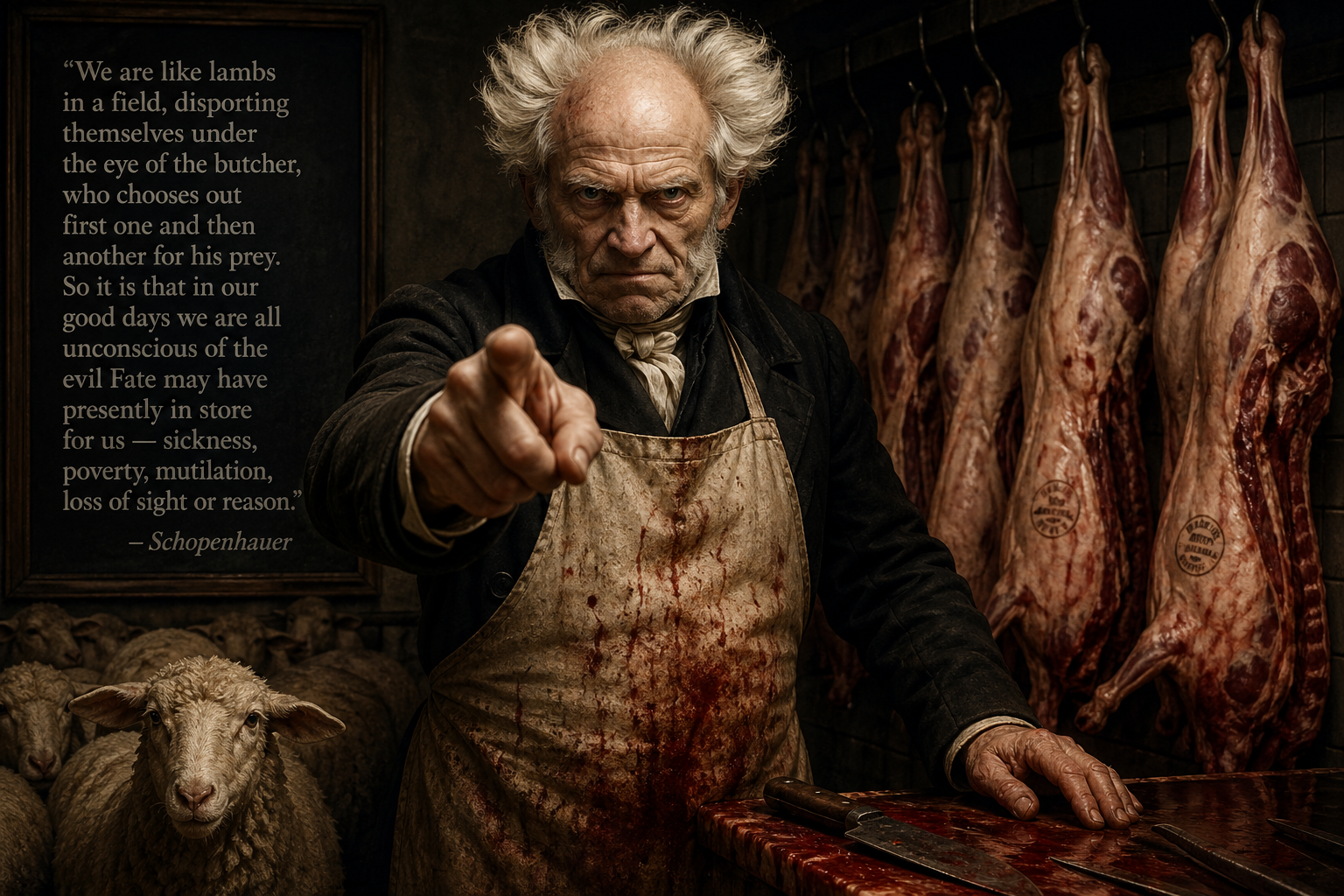
“We are like lambs in a field, disporting themselves under the eye of the butcher, who chooses out first one and then another for his prey. So it is that in our good days we are all unconscious of the evil Fate may have presently in store for us — sickness, poverty, mutilation, loss of sight or reason.”
He only mentions a handful of maladies there — and what about all the rest?
Yet the crucial word, the defining word for this article is butcher.
The butcher is not a literal conscious agent standing over mankind with a blood-splashed apron and meat cleaver. It is the impersonal unfolding of ominous contingency itself: illness, accident, decay, humiliation, loss. These are not anomalies or cosmic mistakes; they are structural features of embodied existence. To be born as a living organism is to become vulnerable to deterioration.
The butcher represents suffering in waiting.
It is the possibility hanging silently over every life, selecting without warning and without fairness. One person is chosen early, another late, but all stand within sight of the finger.
The great comedian Rodney Dangerfield once described his life as being crushed beneath constant pressure. He called it “the heaviness”.
“It’s always on top of me, this heaviness.”
That heaviness is the awareness — however suppressed — that the butcher’s finger may eventually land upon us. It is existence lived under suspended sentence. Not the theatrical version of Russian roulette romanticised in films, but the genuine article: the revolver pressed against the temple while the chamber continues to turn invisibly through time.
Schopenhauer’s use of the word disporting is brilliant. It evokes children running about in carefree delight, leaping and laughing without the slightest awareness of catastrophe. Adults observing them know something the children do not. Childhood appears almost enchanted because it remains partially insulated from the consciousness of contingency.
Adults are no longer so fortunate.
They are full of care because they are full of commitments: work, debt, illness, obligations, responsibilities, anxieties about the future. The heaviness settles upon them like Atlas bearing the heavens upon his shoulders. As Schopenhauer himself observed, work, worry, labour, and trouble form the lot of almost all people throughout the greater part of their lives.
Another passage from the essay captures this perfectly:
“In early youth, as we contemplate our coming life, we are like children in a theatre before the curtain is raised, sitting there in high spirits and eagerly waiting for the play to begin. It is a blessing that we do not know what is really going to happen.”
This applies just as much to modern youth. Students sipping lattes on university campuses, nibbling avocado toast, speaking confidently of careers, ambitions, travel, relationships, and self-discovery. They have inherited the accumulated protections of Western civilisation: medicine, sanitation, industrial production, scientific advancement. All the machinery necessary to deliver them safely into adulthood.
And yet none of it abolishes the butcher.
Bourgeois comfort merely obscures him temporarily.
The modern fantasy is that sufficient prosperity, education, or technological progress can permanently shield one from tragedy. But the butcher’s finger does not recognise class privilege, wealth, beauty, or status. To be born with a silver spoon in one’s mouth is not immunity from deterioration. Disease does not consult bank accounts before entering the body.
This is the part of Schopenhauer’s metaphor that lands like a physical blow:
“chooses out first one and then another.”
Ultimately, it is only a question of sequence.
Some handsome athlete blessed with health, strength, wealth, career prospects, and endless romantic attention may appear invincible in the eyes of others. Yet he too remains livestock beneath the butcher’s gaze. One day he may be lounging upon pristine white beaches beneath tropical sunlight, cocktail in hand, embodying the cliché image of someone “living their best life”.
Then the next day arrives.
The finger points.
A diagnosis. An accident. A collapse. A funeral.
The field continues on without him.
What Schopenhauer understood with terrifying clarity is that suffering is not exceptional. The exceptional thing is merely the temporary reprieve. Human beings spend much of their lives behaving as though stability were the natural order of things, when in reality stability is often nothing more than a brief interval between disasters.
Even the dull brute, lacking intellectual depth or moral sensitivity, cannot escape this condition. Such a creature may live entirely within the immediacy of the present moment, concerned only with visible and immediate needs. Yet ignorance does not grant exemption. The butcher’s finger reaches the simple and the sophisticated alike.
This is why fear of being forgotten by others is ultimately misplaced.
Those who forget you will themselves be forgotten soon enough.
The butcher chooses out first one and then another.