 1
1
 0
0
I had some time and I’ve revisited John Locke’s Two Treatises of Government, a major work in classical liberal political philosophy. Book II, Chapter V, “Of Property”, now that has caught my interest!
What fascinates me about this chapter is that its implications extend beyond politics and economics into psychology, anthropology and the philosophy of the mind—yeah it’s that rich. Locke is attempting to explain something that we often take for granted: how does something in the natural world become mine?
I shall call this the original law of nature for the beginning of property, borrowing Locke’s own phrase from section 30. It is a significant phenomenon worthy of our contemplation I think.
“God, who hath given the World to Men in common, hath also given them reason to make use of it to the best advantage of Life, and convenience.”
— John Locke, Second Treatise of Government, Book II, Chapter V, §26.
And there it is: within Locke’s theological framework, the Earth is mankind’s common inheritance, a natural world provided for the support and comfort of human flourishing. Before the establishment of private enclosures, the fruits of nature are available to mankind in common. Nobody possesses an original, exclusive dominion over every apple tree, river, animal or tract of land simply by virtue of existing.
The world is a common treasury of natural resources, awaiting appropriation through human activity.
But this raises an interesting problem. If the Earth and its fruits belong to everyone in common, how can any individual legitimately claim something exclusively for themselves? How does an object cross the threshold from being common to becoming MY private property?
Locke addresses this problem directly:
“No body has originally a private Dominion, exclusive of the rest of Mankind, in any of them, as they are thus in their natural state.”
His solution is labour. In the original state of nature, natural resources have not yet been appropriated by an individual. Locke argues that when someone mixes their labour with a resource, they establish a private claim to it. The common status of the object is transformed through the act of appropriation.
The important distinction is between the object as it exists in nature and the object as it becomes incorporated into an individual’s possession through their activity.
The labour of the individual
Locke’s argument rests upon a particular conception of the individual:
“Though the Earth, and all inferior Creatures, be common to all Men, yet every Man has a Property in his own Person. This no Body has any Right to but himself. The Labour of his Body, and the Work of his Hands, we may say, are properly his.”
Here Locke establishes the foundation of his theory. The individual possesses their own person, and their labour belongs to them. Through the employment of that labour, they can appropriate resources that were previously held in common.
Consider what this means. The capacity to labour is embodied in the individual. It is expressed through the movements of the body, the hands, the exertion of muscles and the purposeful manipulation of the surrounding environment. Labour is not some detached entity floating independently of the person; it is an activity performed by a living organism upon the world.
Locke’s argument is that this activity establishes a distinction between the individual and the commons.
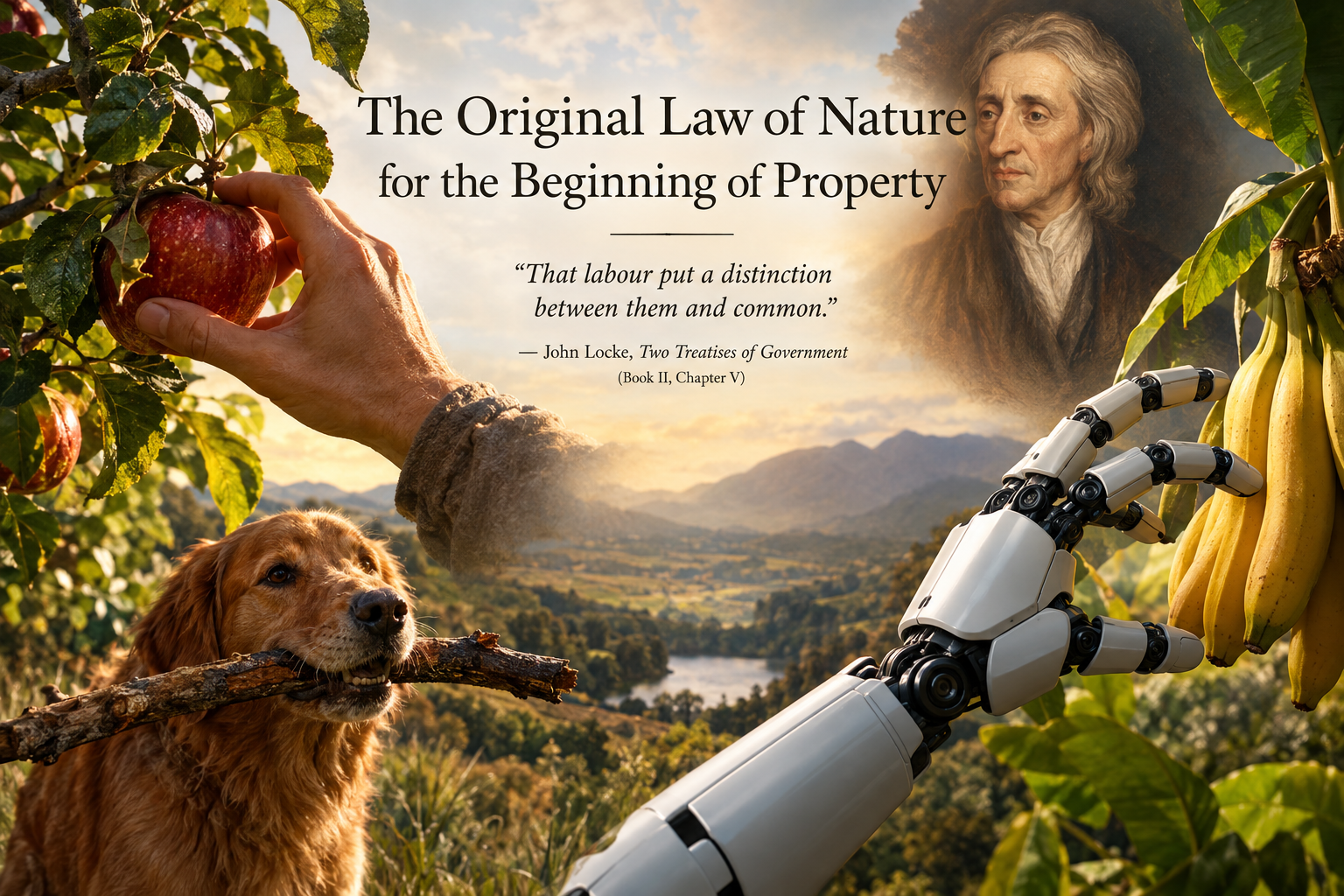
Imagine taking a countryside stroll through woodland untouched by modern civilisation. The morning mist hangs between the trees. I reach up, pluck an apple from a branch and hold it in my hand. A moment earlier, that apple was part of the natural world, available to be appropriated. Now I have removed it from its natural state and brought it into my possession.
What has changed?
The apple itself has not necessarily changed in any substantial physical sense. It remains an apple, composed of the same biological material. Yet its relationship to me has changed. I have performed an action upon it, and I now regard it as something I possess.
Locke expresses this transformation in section 28:
“That labour put a distinction between them and common. That added something to them more than Nature, the common Mother of all, had done; and so they became his private right.”
The apple’s transformation into private property is not a transformation of its physical substance into something metaphysically different. Rather, it is a transformation in its relationship to the individual who has appropriated it.
The apple becomes mine. Consider the simplicity of the act: fingers curl around an object, the hand closes, and the object is removed from its previous location. Yet we attach an extraordinary significance to this otherwise mundane physical interaction. We distinguish between my apple and your apple, between what belongs to me and what belongs to someone else.
The word mine expresses a possessive relationship. It identifies an object as belonging to a particular individual, distinguishing it from the wider world of things that remain unappropriated or belong to others.
But here is where my own interpretation begins to diverge from Locke’s. Is the apple mine merely because I picked it? Or is it mine because I, and potentially other people, recognise it as my possession?
From a conventional perspective, the apple I picked up belongs to me. Yet the concept of property seems to involve more than the physical act of grasping an object. It also involves a judgement about the relationship between the object and its possessor.
If someone snatches the apple from my hand, I regard the act as theft. I believe that the apple is mine and that the other person has violated my claim to it. If another person witnesses the incident, they may recognise my claim and judge the other person’s behaviour to be wrongful.
We have moved beyond the physical apple into a conceptual and social world of possession, entitlement and exclusion. The apple is a physical object. Ownership is a status attributed to the relationship between that object and an individual.
This raises the possibility that what we call property has two distinguishable dimensions: the act of appropriation itself, and the recognition of that appropriation as a legitimate claim.
Thieving Dog
Alright, so I’ve walked with Comicus taking his dog out for a trot many times, countless times. But I’ve recognised a pattern. As we chat and take the dog for a walk through the woods sometimes I pick up an ordinary, dry stick lying on the woodland floor and instantly the dog locks on it.
The stick is unremarkable… I mean really it’s just simply a piece of plant matter that happened to be within our path. Its got no inherent qualities that makes it especially valuable. Yet the dog may seize it, carry it away and resist attempts by us or another dog to take it. The stick becomes the focus of possessive behaviour. The dog does not necessarily care about every other stick scattered throughout the woodland. Its attention is directed towards this particular object because I picked it up!
Even the dog sees a relationship there, the stick has acquired significance through my interaction and then the canine’s interaction with it by stealing it. It has become the object of a possessive relationship and might I add again—the bitch stole it! The dog is female!
Of course, a dog’s behaviour does not establish that it possesses a human concept of legal ownership, nor does it prove Locke’s theory. But the example raises an interesting psychological question: how much of what we call possession originates in the organism’s interaction with an object, and how much depends upon the conceptual and social frameworks through which possession is understood?
Property extends beyond the grasping hand
In humans, the possessive relationship can extend far beyond our immediate vicinity. We claim ownership of houses we are not occupying, land we may never visit and objects stored thousands of miles away… but it’s ours. Our understanding of property can persist without our hands ever touching the thing we own. This suggests that the psychology of possession and the institution of property, although related, are not identical. Locke does not restrict his argument to apples, acorns and other natural resources that can be gathered by hand. He extends it to the appropriation of land itself.
He writes:
“As much Land as a Man tills, Plants, Improves, Cultivates, and can use the Product of, so much is his Property.”
For Locke, labour distinguishes cultivated land from land left uncultivated. The individual who tills the soil, plants crops and improves its productivity has, in his account, added something of their own to the natural world. He argues that labour accounts for much of the value of land and its products. In section 40, he compares the productive output of cultivated English land with uncultivated land in America, concluding that labour contributes substantially more value than nature alone.
This argument moves beyond the simple gathering of natural resources. It presents productive improvement as a justification for private appropriation.
Yet it also introduces a significant problem. Does making land more productive necessarily confer an exclusive moral right to it? And who decides what counts as improvement?
Locke’s comparison between cultivated European land and Indigenous American land reflects the assumptions of his historical context. Land that did not conform to European agricultural practices could be treated as insufficiently improved, even where Indigenous peoples already inhabited, managed and used it according to their own systems.
We should therefore distinguish Locke’s philosophical argument from the historical assumptions through which he applies it. Land is not necessarily unowned merely because an outsider considers its use unproductive.
The question of property cannot be settled simply by pointing to the presence or absence of a particular form of labour.
My take: property as a recognised relationship
Alright, here’s my take on what I think. So Locke argues that labour establishes the original claim to property and the labourer appropriates something from the commons and thereby makes it their own.
But I want to examine the nature of that claim itself!
Simply put, I suspect that property, as a social institution, depends upon human recognition and agreement, whether expressed orally, through established customs, or formally codified in deeds, laws and other legal arrangements.
If I pluck an apple from a tree, I regard it as mine. But if another person disputes my claim, we encounter the question of what makes that claim legitimate and binding upon anyone else—so who the heck is right?
My effort alone cannot guarantee that other people will recognise my ownership. I may have picked the apple, but another person could simply take it from me. My physical act of appropriation and my socially recognised right to possession are different things.
This is where I find a distinction worth exploring: labour may explain how an individual comes to possess an object, but it does not, by itself, explain why everyone else ought to respect that possession.
The physical act and the normative claim are not identical. A society establishes conventions, rules and institutions that determine which claims to property it recognises, how ownership can be transferred, and what constitutes theft or trespass. These arrangements do not create the physical apple, but they shape the social status attached to it.
I would therefore distinguish between the initial act of appropriation and the subsequent recognition of ownership. Locke attempts to explain the former through natural law; my interest is in how the latter becomes intelligible and enforceable within a social world. This does not mean Locke believes that property originates in explicit human agreement. Quite the opposite: his argument is specifically intended to explain how individuals can acquire property without obtaining the express consent of everyone else. My argument concerns a further question: how does an individual’s claim become a socially recognised right?
I was once asked whether robots could claim property. We are entering an age in which artificial intelligence is being integrated with robotics, producing machines capable of manipulating physical objects with increasingly sophisticated mechanical hands, grippers and other actuators. Suppose a robot reaches up and picks a bunch of bananas from a tree.
Does the act of labour make those bananas the robot’s property?
If we approach the question strictly through Locke’s own framework, the answer is far from straightforward. Locke grounds his argument in the property individuals have in their own persons, the common inheritance of humanity, and the natural law he understands through reason and divine provision. His theory does not simply establish that any entity capable of manipulating an object thereby acquires a legitimate right to own it.
A robot is not a human being in Locke’s sense, nor is it straightforwardly one of the beneficiaries of the divine grant upon which his argument rests.
Why should the capacity to labour establish property rights for one kind of entity but not another? If the relevant act is the purposeful application of effort to an object, then a machine’s physical ability to pick fruit presents a challenge to any theory that treats labour alone as sufficient to establish ownership.
Of course, a robot’s capacity to perform a task does not automatically settle whether it can own property. We would also have to consider agency, legal personhood, responsibility and the social recognition of its claims. A machine might perform labour on behalf of a human owner or company without possessing the resulting goods itself.
Nevertheless, the example exposes an assumption in Locke’s theory that becomes increasingly interesting as technology advances: the relationship between labour, the individual who performs it, and the right to appropriate the fruits of that labour.
If future artificial agents were recognised as independent actors, capable of pursuing their own objectives and participating in social institutions, would we need to reconsider the boundaries of property ownership?
The original law of nature for the beginning of property
Locke’s chapter begins with a world held in common and attempts to explain how private property emerges from it. Labour is the mechanism through which the individual establishes a claim over something previously available to all.
Yet the concept of property reaches beyond the physical act of gathering, grasping or cultivating. It involves a relationship between an object and its possessor, a distinction between what is mine and what is not mine, and a set of judgements about the legitimacy of that distinction.
The apple is an object of nature. The act of picking it is an instance of labour. The claim that it belongs to me is a proposition about ownership.
These are related, but they are not the same thing.
Locke’s original law of nature for the beginning of property seeks to explain the transition from the commons to the private right of the individual. My own interest is in the conceptual and social transformation that accompanies that transition: how an object comes to be identified as someone’s possession, and why that identification acquires authority over the behaviour of others.
The hand reaches out, the fingers close around the apple, and a distinction is made between the individual and the commons.
But the deeper question remains: what makes that distinction a right?