1
1
 0
0
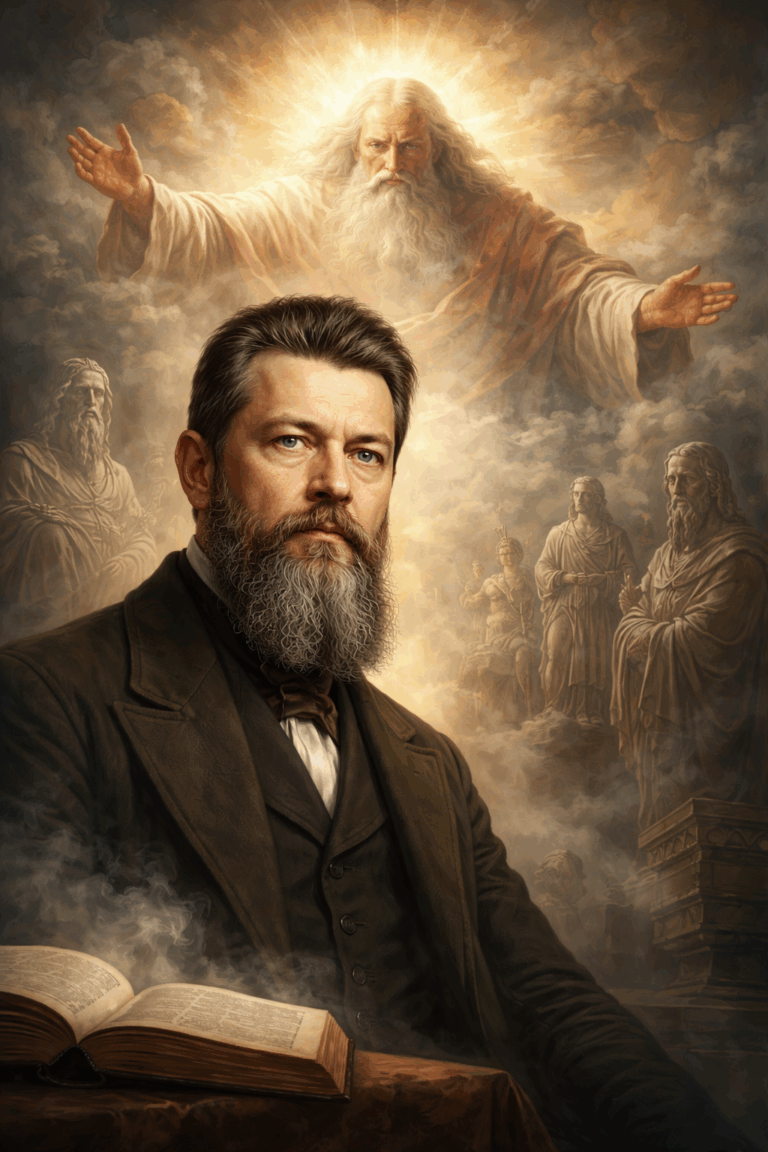
There is a familiar claim in religion: God created the world. It is presented as a statement about reality, a metaphysical fact about the origin of things. But in The Essence of Christianity, Ludwig Feuerbach invites us to read it differently—not as a revelation about God, but as a revelation about man. The inspiration for this article is this passage:
“The idea of activity, of making of creation, is in itself a divine idea; it is therefore unhesitatingly applied to God. In activity, man feels himself free, unlimited, happy; in passivity, limited, oppressed, unhappy. Activity is the positive sense of one’s personality. That is positive which in man is accompanied with joy; hence God is, as we have already said, the idea of pure, unlimited joy. We succeed only in what we do willingly; joyful effort conquers all things. But that is joyful activity which is in accordance with our nature, which we do not feel as a limitation, and consequently not as a constraint. And the happiest, the most blissful activity is that which is productive. To read is delightful, reading is passive activity; but to produce what is worthy to be read is more delightful still. It is more blessed to give than to receive. Hence this attribute of the species – productive activity – is assigned to God; that is, realised and made objective as divine activity.”
Man creates, and in creating, he feels something peculiar: a sense of freedom, of efficacy, of satisfaction. He brings something into being that did not exist before. He shapes the world through his own activity by taking the raw materials of nature and using his tools fashions them into novel forms for his benefit. And in that moment, he experiences himself not as passive, not as subject to the world, but as a cause within it.
This experience is not trivial, ladies and gentlemen. I believe it is one of the deepest affirmations of human existence.
Consider something simple. I build a wall. Before, there was no boundary—now there is. I have defined a space, altered the environment, produced something that stands outside me yet bears my mark. Others can see it, touch it, react to it. It is an objective manifestation of my will. I step back, hands on hips, and nod to myself: I did that.
There is something of the divine in this moment of creating something you did. It is not that the act is supernatural, God no! (excuse the pun), it is entirely natural, grounded in the labour of the body and the constraints of material conditions. But the feeling it produces—the sense of having created, of having imposed form upon the world—is expansive. It carries with it a quiet intimation of freedom, even of power. Feuerbach’s insight is that this experience does not remain where it arises. It is taken up by the mind, abstracted, intensified, and projected outward.
Man does not simply create—he reflects upon creation. He isolates what is essential in the act: the bringing-forth of something external to oneself. He strips away the limitations: the tools required, the time expended, the resistance of matter, the narrow scope of any particular craft. What remains is the pure idea of creation itself. This what is missed out on, he attributes this to God.
God becomes the creator—not because such a being has been discovered, but because man has recognised, in his own productive activity, something he experiences as ultimate. The joy of creation, the affirmation of self in activity, the sense of freedom in bringing something into existence—these are elevated into the limitless heavens of theology.
But in this elevation, something changes.
The carpenter produces furniture. The builder produces structures. The baker produces bread. The writer produces text. Each form of activity is specific, concrete, and therefore limited. Each is bound to a domain, to materials, to skill, to circumstance.
God, however, is not limited in this way.
Through the imagination, man amplifies his own productive capacity into an absolute. All particular forms of labour are stripped away, and what remains is pure productivity itself—creation without constraint, activity without limit. God is not a carpenter among carpenters; He is pure creation unfettered by the laws of physics. In this way, the most human of experiences becomes the most divine of attributes—only the best!
When our ancestors or ourselves set out to work, activity is not external to us; it defines us as human beings. What we do shapes how we think. Occupation is not merely a means of survival—it becomes a lens through which we interpret the world. It furnishes us with meaning and forms the core of our being.
It is therefore no surprise that individuals elevate their own activity. Do we not see the artist extole art as the highest expression of humanity? Then we shift attention and observe the scientist sees knowledge as paramount? The builder sees construction as foundational and important? Each, in a sense, absolutises his own domain. The staff down at a local Tesco will justify their work activity as important to feeding the community.
This is often dismissed as ego or a search for validation. But it runs deeper. It is ontological. Activity is the medium through which man experiences himself as real, as effective, as present in the world. It is the positive expression of his personality in opposition to passivity like some couch potato, because in passivity, Feuerbach argues, we are “limited, oppressed, unhappy”
Feuerbach’s point can be taken one step further. There is a dialectical movement at work here: activity shapes the mind, but the mind in turn reshapes activity. Man produces, and in producing, he forms a conception of himself. That conception then feeds back into how he acts, what he values, what he elevates. In their interaction, both are continually transformed.
Within this movement, productive activity emerges as the highest form of fulfilment. It is not merely doing, but bringing forth; not merely acting, but creating. In it, man experiences a freedom that feels unbounded, even if, in reality, it is constrained on all sides by necessity.
Religion takes the experience of creation—of joyful, self-affirming activity—and projects it beyond man. It removes the limits of reality and physics and posits it as the activity of an absolute being. God creates the world as I created my wall, but the Lord does so without tools, without effort, without resistance or worrying about the next meal.
In this light, the doctrine of divine creation is not a statement about the origin of the universe. It is the idealised reflection of human productive life or what Marx would call species-being. Productive activity is a defning feature of the human species and maybe beavers, but the species capability of producing things separates us from animals. God as creator is nothing other than man as divine producer, seen through the lens of the highly evolved imagination of human beings and stripped of all limitation. The power attributed to God is real in the minds of believers—but it ultimately belongs to man as his most pervasive abstraction. To understand God as creator, we should not to look beyond the world, but into human beings and their activity itself, to anthropology. For in the act of creation—in the shaping of the external world according to internal purpose—man encounters the very experience he later calls divine in religion.
And this is where we return to Feuerbach who reveals the dialectical extremes of God compared to man:
“RELIGION is the disuniting of man from himself; he sets God before him as the antithesis of himself God is not what man is – man is not what God is. God is the infinite, man the finite being; God is perfect, man imperfect; God eternal, man temporal; God almighty, man weak; God holy, man sinful. God and man are extremes: God is the absolutely positive, the sum of all realities; man the absolutely negative, comprehending all negations.”
And yet, the creator is actually a figment borne out of the wild abstractions of mankind. God, in the end, is not the creator of man. He is the reflection of man as the true creator.